08
Castle Keep
Once the high tower, later also called Lehenturm
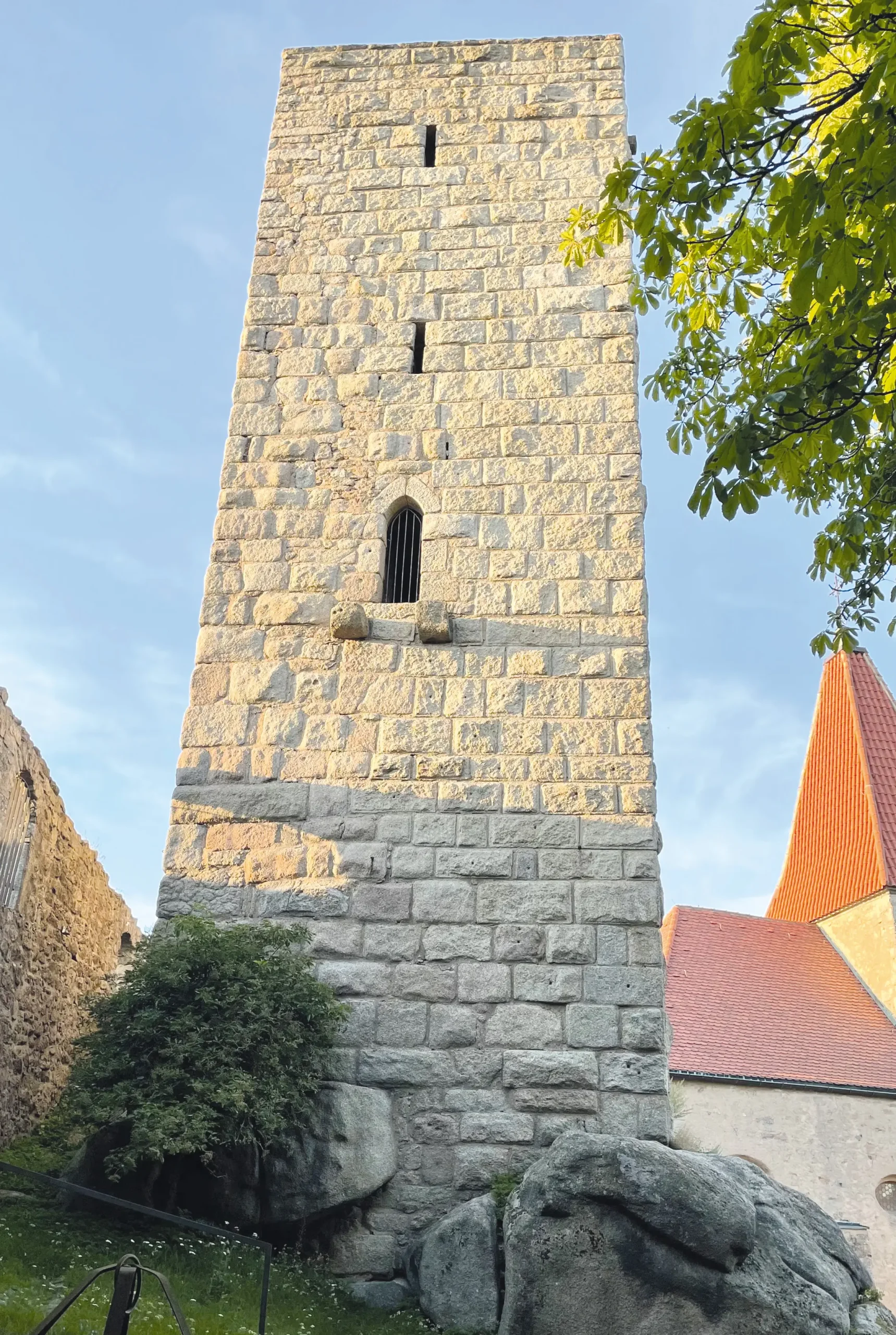
Once known as the “High Tower”, later also called the feudal tower, the castle keep (Bergfried), which today stands 24 metres high, rises on a massive granite outcrop. Historical records already mention the first reconstruction of the tower in 1225. At that time, it originally had a larger circumference and a height of approximately 30 metres. Around this period, Landgrave Diepold II transferred the castle for 200 guilders to Count Heinrich of Ortenburg, who committed to using 30 guilders for the reconstruction of the tower and to redeem the landgrave’s pledge. The lower and broader part of the tower visible today likely still contains remnants of this reconstruction.
Around the year 1300, the tower was renewed by Landgrave Ulrich I of Leuchtenberg. The castle keep served both as a last place of refuge during times of siege and as a visible status symbol of the castle lords. Until 1642, the tower was covered with wooden shingles, and the original battlemented crown was reconstructed during the restoration carried out in 1902/1903.
During a violent storm in July 1646, lightning struck the rear left corner of the tower, causing significant damage. The court clerk at the time reported that large stone blocks were blasted out and that the roof over the cellar as well as the staircase to the guardroom were severely damaged. The damage was repaired only provisionally using bricks and was presumably the last major repair carried out during the period of the Landgraves of Leuchtenberg.
In 1781, the district administrator mentioned another repair of the tower and spoke of tall scaffolding and considerable danger involved in bringing up the building materials. At the beginning of the 19th century, the height was still almost 30 metres. In 1803, District Administrator Gregor Meixner attempted to reduce the height of the tower but was only able to remove about six feet (just under two metres).
In 1888, the castle keep was struck by lightning once again and blasted apart from top to bottom, causing the eastern half to collapse towards the village—an event clearly visible in historical photographs. In 1902/1903, the collapsed half was rebuilt, with the masonry technique adapted to the remaining western side. These differences are still clearly visible in the masonry today.
The original entrance to the tower was located at an elevated position in the inner courtyard and was connected to the central wing by a small drawbridge. The present entrance on the lower front side was broken through and secured during the reconstruction of 1902/1903. On the large lower rock face, stone-carved steps and a notch are still visible, from which a wooden staircase once led up to the guardroom. On the higher rock face, there are also two recesses where pitch pans once stood, used to illuminate the inner courtyard in the evening.
Today, the castle keep is a popular viewing point, offering a magnificent panoramic view over the Upper Palatinate Forest and far beyond.